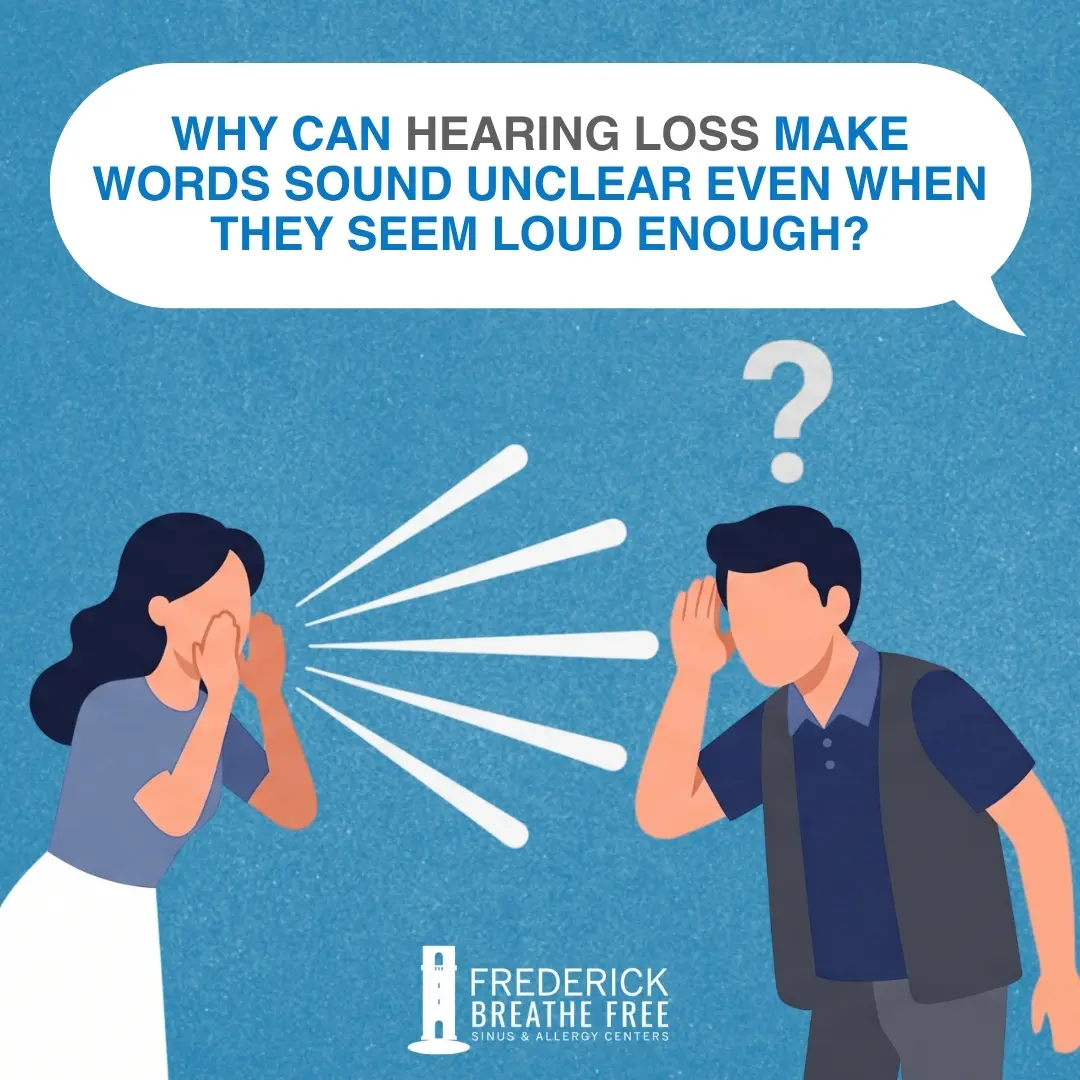
Why Can Hearing Loss Make Words Sound Unclear Even When They Seem Loud Enough?
You can hear that someone is speaking, yet the words sound muffled, incomplete, or jumbled. Turning up the television may make it louder without making the dialogue easier to understand. In a restaurant or crowded room, following the conversation may become especially difficult.
This can happen because hearing loss does not affect volume alone. It may also reduce access to the subtle sound details that allow the brain to distinguish one word from another.
At Frederick Breathe Free, the clinical team helps patients in Frederick and nearby Maryland communities evaluate hearing changes and identify factors that may be affecting speech clarity.
Why Do Words Sound Loud but Unclear?
Vowel sounds carry much of the volume and rhythm of speech, while softer consonants provide many of the details that distinguish words. Certain forms of hearing loss affect higher-frequency sounds first, making consonants such as “s,” “f,” “th,” “sh,” “t,” and “k” harder to detect.
A person may therefore hear that someone is talking but miss enough speech information that words sound mumbled or incomplete.
Increasing the volume may help make speech more audible, but it cannot always restore sound details that the auditory system is no longer transmitting clearly.
Hearing Involves More Than Detecting Sound
Hearing begins when sound waves enter the ear canal and vibrate the eardrum. These vibrations travel through the middle ear and into the cochlea, the hearing organ inside the inner ear.
Tiny sensory hair cells in the cochlea respond to different sound frequencies and convert those vibrations into signals. The auditory nerve carries the signals to the brain, which identifies speech, music, and environmental sounds.
A problem at any point in this system may affect:
- How loud a sound seems
- Which frequencies are detected
- How clearly speech is understood
- How well competing sounds can be separated
- How much listening effort is required
That is why two people with similar hearing thresholds may report different levels of difficulty understanding conversation.
Why Are Consonants Important for Speech Clarity?
Vowels such as “a,” “e,” and “o” are generally louder and lower in frequency. They help speech sound audible and provide its rhythm.
Many consonants are softer and contain more high-frequency information. They help distinguish words such as:
- “Cat” and “hat”
- “Sit” and “fit”
- “Tea” and “key”
- “Fifty” and “sixty”
- “Pat” and “bat”
If some consonant sounds are not detected clearly, the brain receives an incomplete version of the word. It then uses context, lip movements, and prior knowledge to guess what was said.
In a quiet room, that guessing may work reasonably well. In background noise, the missing information becomes much harder to reconstruct.
How Does Sensorineural Hearing Loss Affect Clarity?
Sensorineural hearing loss occurs when the inner ear, auditory nerve, or both are not functioning normally. Common contributing factors include aging, repeated noise exposure, genetics, certain medications, and some medical conditions.
Damage to cochlear hair cells may reduce sensitivity to particular frequencies. It can also make sound quality less precise.
As a result:
- Speech may sound distorted rather than simply quiet
- Similar consonants may be confused
- Loud sounds may become uncomfortable quickly
- Increasing volume may provide limited improvement in clarity
- Understanding speech in noise may become disproportionately difficult
Sensorineural hearing loss is commonly permanent, but hearing technology and communication strategies may improve access to speech for many patients. Results vary according to the degree and pattern of hearing loss.
Why Is Background Noise So Difficult?
Even people with normal hearing may struggle in a loud restaurant. Hearing loss can make the task significantly harder.
Background Noise Covers Softer Speech Sounds
Music, dishes, ventilation systems, and nearby conversations may mask the softer consonants needed for speech clarity.
The louder vowel sounds remain audible, so you know someone is speaking, but important details disappear into the background.
Voices May Come From Several Directions
The brain uses differences between the ears to determine where a sound is coming from and focus attention on a particular speaker.
Hearing loss in one or both ears can make separating the target voice from competing sounds more difficult.
Damaged Hearing May Reduce Frequency Separation
A healthy auditory system can distinguish sounds that are close together in pitch. With sensorineural hearing loss, different sounds may be represented less distinctly.
Speech and background noise can therefore seem to blend together.
The Brain Must Work Harder
When the auditory signal is incomplete, the brain uses additional attention and memory to fill in the gaps.
This increased listening effort may cause:
- Mental fatigue
- Difficulty following group conversations
- Trouble remembering what was said
- Withdrawal from social settings
- Frustration or irritability after prolonged listening
Listening fatigue is not a sign that someone is failing to concentrate. It may reflect how much work the brain is doing to interpret an unclear signal.
What Are the Subtle Signs of Hearing Changes?
Possible signs include:
- Frequently asking people to repeat themselves
- Feeling that everyone mumbles
- Turning the television volume higher than others prefer
- Misunderstanding similar-sounding words
- Struggling to follow conversations in restaurants
- Having more difficulty understanding women or children
- Relying on facial expressions or lip movements
- Hearing better when a speaker is directly in front of you
- Feeling exhausted after meetings or social events
- Avoiding phone conversations
- Missing doorbells, alarms, or other higher-pitched sounds
These experiences do not automatically establish hearing loss. A hearing evaluation can help determine whether a measurable change is present.
Could Earwax or Middle-Ear Pressure Affect Speech Clarity?
Yes. Not every muffled or unclear sound is caused by permanent inner-ear hearing loss.
Earwax
A significant wax blockage can prevent sound from traveling normally through the ear canal. This may cause fullness and conductive hearing loss.
Middle-Ear Fluid
Fluid behind the eardrum can dampen sound vibrations and make hearing seem muffled or underwater.
Eustachian Tube Dysfunction
Poor pressure regulation in the middle ear may cause fullness, popping, and temporary hearing changes.
Ear Infection
Inflammation or fluid associated with an ear infection may temporarily affect hearing.
Nasal and Sinus Inflammation
Sinus inflammation and allergies may affect eustachian tube function, contributing to middle-ear pressure or fluid. Treating the underlying inflammation may improve hearing when the problem is conductive and temporary.
An examination can help distinguish these conditions from sensorineural hearing loss.
Could Another Inner-Ear Condition Be Responsible?
Several conditions may cause hearing changes beyond gradual sensorineural loss.
For example, Ménière’s disease may cause fluctuating hearing, tinnitus, ear fullness, and episodes of vertigo. Certain medications, infections, autoimmune conditions, and noise exposure may also affect inner-ear function.
The timing and pattern of symptoms provide important clues. Hearing that changes suddenly requires a different response from gradual difficulty understanding speech.
How Does a Hearing Test Measure Clarity?
A comprehensive hearing evaluation may include more than listening for beeps.
Pure-Tone Testing
Pure-tone testing identifies the softest sounds a person can detect at different frequencies. The results are displayed on an audiogram.
This shows whether hearing loss is present and which pitches are affected.
Speech-Recognition Testing
Speech testing evaluates how softly speech can be detected and how accurately words are repeated at a comfortable listening level.
Word-recognition results provide information about clarity. A person may hear that speech is present but still have difficulty identifying the words correctly.
Middle-Ear Testing
Tympanometry evaluates eardrum movement and middle-ear pressure. This may help identify fluid, pressure changes, or another mechanical problem.
The results of these tests are interpreted together. No single number describes every real-world listening difficulty.
Why Does Making Everything Louder Not Always Work?
Amplification can make sounds more audible, but loudness and clarity are different.
If the auditory system is not transmitting certain frequencies accurately, raising the overall volume may amplify both speech and background noise. It may also make already audible sounds uncomfortable without restoring every missing speech cue.
Properly selected and programmed hearing technology can provide frequency-specific amplification rather than simply making everything equally louder. Features such as directional microphones and noise management may also support communication in difficult environments.
Even with well-fitted technology, hearing may not return to normal. Realistic expectations, follow-up programming, and communication strategies remain important.
What Communication Strategies May Help?
While waiting for an evaluation or adjusting to treatment, the following strategies may make conversations easier:
- Face the speaker
- Reduce background noise when possible
- Move closer to the person speaking
- Choose well-lit seating
- Ask the speaker to rephrase rather than only repeat
- Select quieter restaurant seating
- Use captions for television or video calls
- Tell others which communication methods help
- Take listening breaks during long events
These strategies do not replace a hearing evaluation, but they may reduce frustration and listening effort.
When Should Hearing Changes Be Evaluated?
Consider scheduling an evaluation if:
- Words frequently sound mumbled or unclear
- Background noise makes conversation unusually difficult
- You repeatedly ask others to speak louder
- One ear hears differently from the other
- Hearing difficulties interfere with work or social activities
- Tinnitus, pressure, or dizziness occurs with hearing changes
- Family members have expressed concern
According to the National Institute on Deafness and Other Communication Disorders, gradual hearing changes are common with age, but hearing difficulty should still be evaluated rather than accepted without testing.
Seek prompt medical care if hearing decreases suddenly in one or both ears, especially when accompanied by tinnitus, dizziness, or fullness. Sudden sensorineural hearing loss is time-sensitive and should not be assumed to be earwax or congestion.
Find Out Why Speech Sounds Unclear
Hearing loss may affect the fine details of speech even when voices seem loud enough. Missing consonants, difficulty separating speech from noise, and increased listening effort can make conversations sound jumbled or incomplete.
Contact Frederick Breathe Free to schedule an evaluation and determine whether hearing loss, earwax, middle-ear pressure, or another condition may be affecting speech clarity.