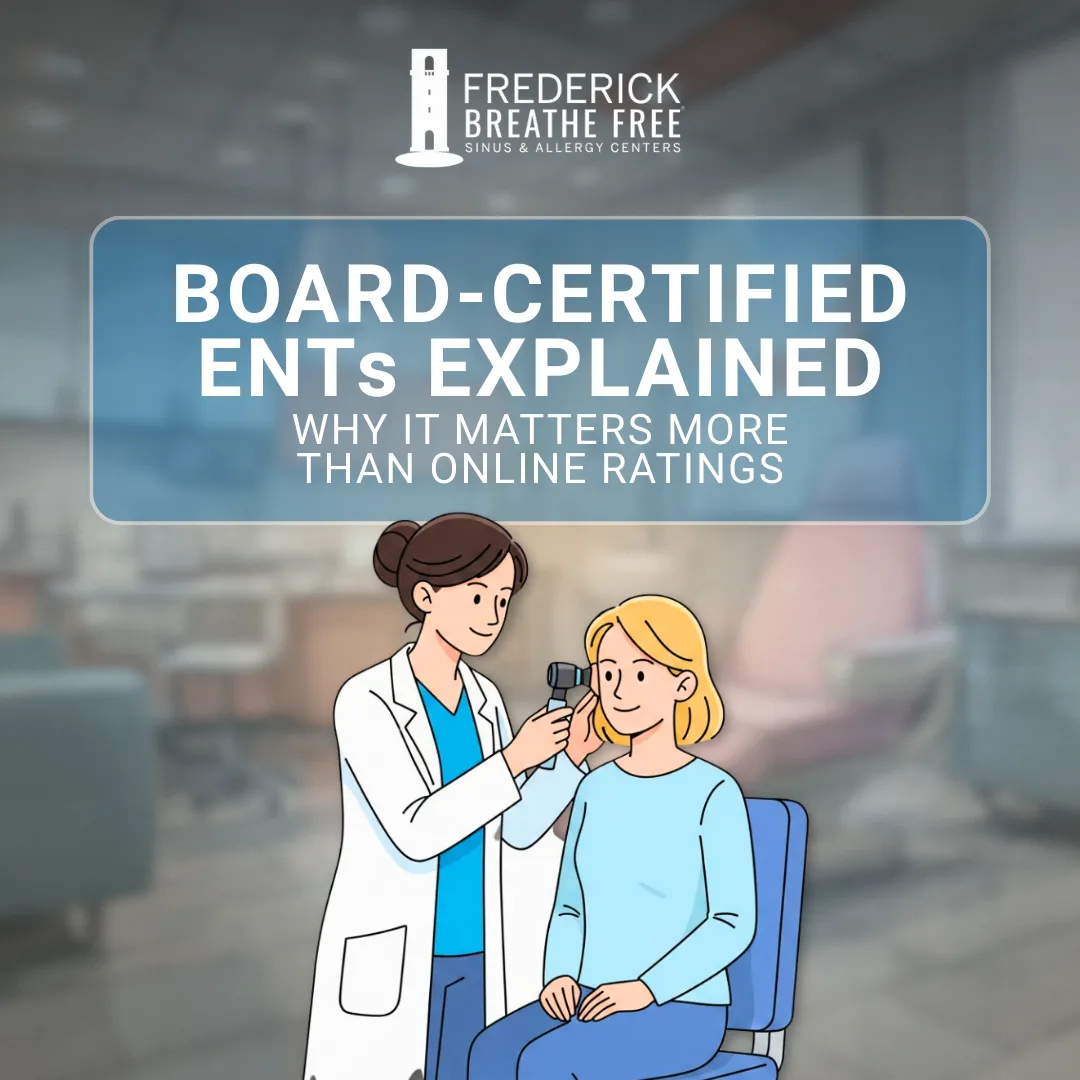
Board-Certified ENTs Explained: Why It Matters More Than Online Ratings
Today’s modern patients are smarter, and they navigate all things concerning their health carefully. Gone are the days when they will pick the first healthcare provider suggested to them. Because everyone believes that their health is very important–and rightfully so–they make sure to thoroughly research and evaluate their options.
In ENT, like in other medical specialties, board certification plays a crucial role in helping patients choose their care provider. Although it doesn’t guarantee patient outcomes on its own, board certification indicates that a physician has met additional training and testing standards in their area of specialty, which some patients consider when choosing a provider.
This guide–provided by Frederick Breathe Free for general information purposes only–aims to help patients in Frederick, MA, understand board-certification in ENT and understand why it matters when choosing a care provider that aligns with your ENT health concerns and goals.
What Is an ENT?
An otolaryngologist, or simply known as an ENT, is a healthcare provider who specializes in diagnosing and treating conditions and diseases affecting the ears, nose, and throat. ENT physicians may also further their ENT specialty in diagnosing and treating issues related to the head, neck, mouth, and facial structures.
Otolaryngologists are specialists. Aspiring individuals must first complete an undergraduate degree and then a medical school education. Following graduation from medical school, those who wish to become ENT specialists must undergo five years of residency training in the field.
Some otolaryngologists may also pursue further education in subspecialties like pediatric otolaryngology, head and neck surgery, and facial reconstructive surgery.
ENT physicians are trained to provide both non-surgical and surgical treatment options to address an array of conditions, such as chronic sinusitis, seasonal allergies, ear infections, hearing loss, and sleep-related breathing disorders.
What Is a Board-Certified ENT in Frederick, MA?
A board-certified ENT in Frederick, MA, is an ENT doctor who has completed medical school and residency training in otolaryngology. Being board-certified indicates that these healthcare specialists have undergone rigorous specialty training and have met industry-wide professional standards set by the American Board of Otolaryngology – Head and Neck Surgery, or ABOHNS.
ABOHNS is a nationally recognized certifying body for otolaryngologists practicing in the United States. It provides certification for physicians who have successfully met training and examination requirements.
To qualify for a certification, physicians must:
- Complete a four-year undergraduate degree program, four years of medical school, and five years of specialty residency training in otolaryngology
- Apply for and pass the primary certification examination process–which includes both the written and oral exams–after completing an accredited residency training in otolaryngology
- Complete continuing certification activities and requirements every year to maintain their certification
A board-certified otolaryngologist may choose to undergo further training for a subspecialty. ABOHNS offers subcertification for three subspecialties, namely, Complex Pediatric Otolaryngology, Neurotology, and Sleep Medicine.
Does ENT Certification Matter?
In the United States, a physician can legally practice medicine if they are licensed by the state in which they practice. An ENT board certification is not a requirement, as their medical license already includes ear, nose, and throat care. However, licensed physicians can choose to pursue certification, and this can indicate that they have undergone specialty training in otolaryngology and have met industry standards, as set by the ABOHNS.
ENT board certification is a voluntary program. Not every ENT practitioner is certified, but it allows specialists to improve their knowledge and performance in ENT care. Additionally, it can demonstrate their commitment to their profession and to their patients.
Patients can check a physician’s certification status at CertificationMatters.org. It’s a free service for all patients and is affiliated with the American Board of Medical Specialties (ABMS).
Why Board Certification Matters More Than Online Ratings
Online patient reviews and testimonials offer potential patients insight into patient experiences. However, board certification can reflect a physician’s commitment to ongoing education, training, and adherence to industry-recognized professional standards in their field. It may also serve as a helpful indicator to help patients evaluate and choose a healthcare provider.
Why it matters
- It indicates that a certain physician has undergone specialty training and has met professional standards in their field of specialty.
- It reflects a physician’s dedication to ongoing education and meeting industry-recognized standards in their field.
- It provides an avenue for physicians to know the latest advancements and technologies in their field of specialty.
- For some patients, board certification may be an important consideration when evaluating healthcare providers.
Disclaimer: While board certification reflects additional specialty education and training, it should be considered alongside patient reviews, clinical experience, and communication style.
Frequently Asked Questions About ENTs in Frederick, MA
What does an ENT treat?
ENT specialists, or otolaryngologists, are trained to diagnose and treat a wide variety of ENT-related issues. While a primary care provider (PCP) can address mild ENT concerns, they may refer you to a specialist if there are certain symptoms, including:
- Chronic nasal congestion
- Persistent sore throat
- Chronic cough
- Difficulty swallowing
- Severe sinus pain and pressure
- Wheezing or hoarseness
- Frequent ear infections
- Hearing loss
- Ringing in the ears with no external source
- Dizziness or vertigo
- Breathing disorders due to anatomical issues
- Lumps in the neck or face
What is the difference between an ENT and an otolaryngologist?
An ENT and an otolaryngologist refer to the same medical specialist.
“ENT” is the more common term used by most people, as it is easier to remember.
“Otolaryngologist” is the official medical term, and most otolaryngologists prefer this term because it recognizes that they are capable of diagnosing and treating more than the conditions of the ear, nose, and throat. It’s also more consistent with the name of the board, certification, and language used by most hospitals and clinics.
What is the difference between a licensed and board-certified doctor?
In the United States, all doctors must have a medical license in the state where they work and practice. This includes ear, nose, and throat care. Licensed doctors may choose to pursue specialty education and training to become board-certified in their area of practice. A medical license is mandatory to practice, while board certification is a voluntary program.
Looking for a Board-Certified ENT Near Me in Frederick, MA
If you’re looking for an ENT care provider and are comparing your options in Frederick, MA, Frederick Breathe Free is one of many ENT care providers in the area. You can learn more about our Frederick ENT services by visiting our website or contacting us directly.
Our provider, Dr. Oberman, is board-certified by the ABOHNS. You can find full credentials and qualifications on our provider page.